

Affiliate disclosure: This post contains affiliate links — we independently select these products, and if you buy from one of our links, we may earn a commission at no cost to you. All prices were accurate at the time of publishing.
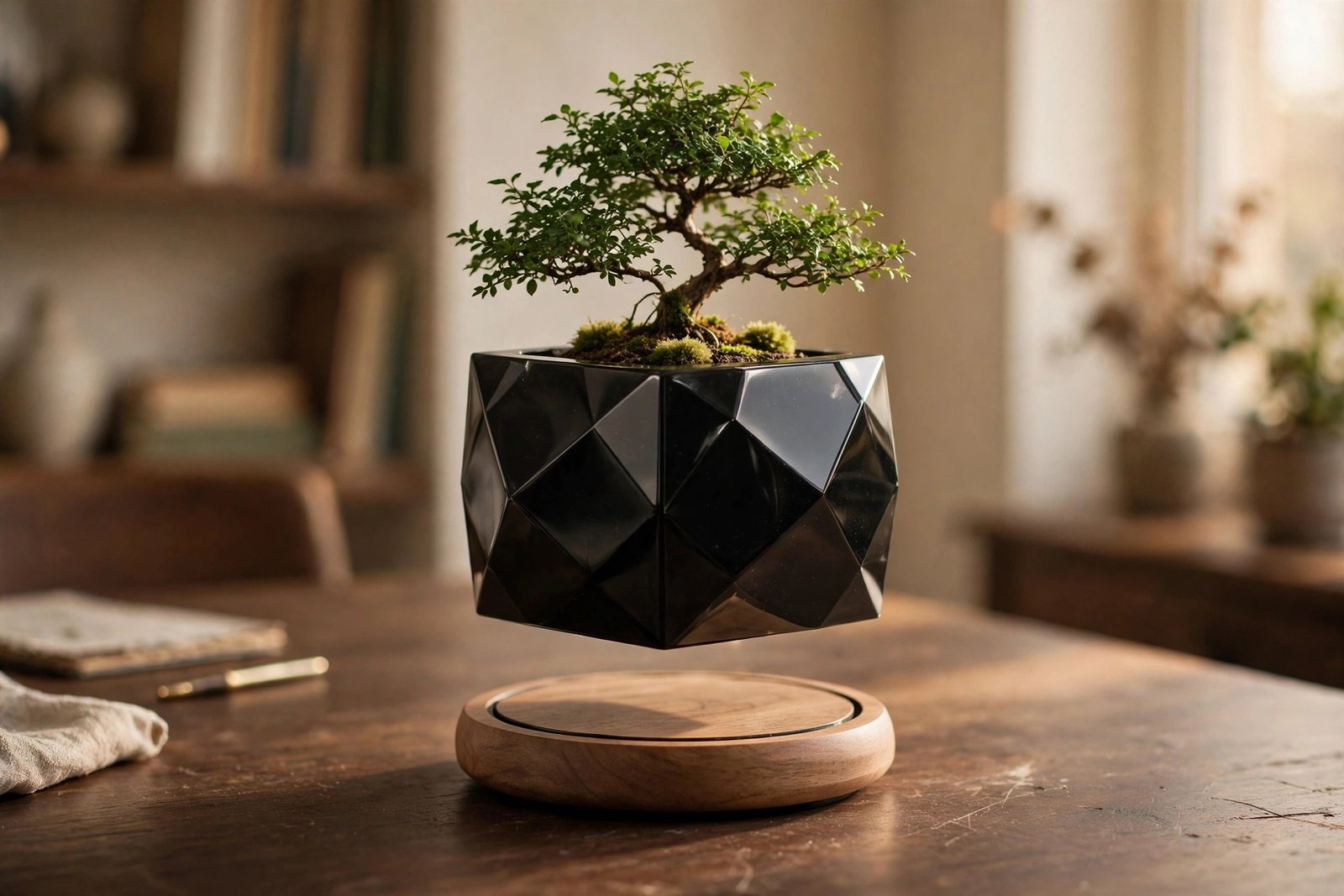
Some objects earn their place in a room by being beautiful. A rare few earn it by being impossible. The Babook Levitating Air Bonsai Pot belongs to the second group: a glossy black faceted planter that hovers in mid-air above a round wooden base, slowly rotating a full 360 degrees, as if your plant became a tiny planet. This week on Cozy Gadget Finds, we put the internet’s favorite floating planter under the microscope — how the levitation actually works, what 836 reviewers really think, and whether the magic survives daily life. Spoiler: with a 4.3-star average across 836 ratings and a long run as an Amazon Garden Pots best-seller, it mostly does — with one honest caveat you should know before buying.
What it is — and how magnetic levitation actually works
The Babook Levitating Air Bonsai Pot is a two-part system: a square, faceted resin planter in a polished dark finish, and a round wooden levitation base. Inside the base sits what Babook calls a patented arrangement of magnets, coils, sensors, and electronics. The sensors read the pot’s position thousands of times per second and continuously adjust the electromagnetic field to keep it suspended — no strings, no wires, no tricks.
The numbers that matter: the whole piece stands about 7 inches tall (roughly 6.99″ deep by 5.02″ wide), the floating pot supports up to 300 grams of plant and soil, and once powered on, the pot begins a slow, silent 360-degree rotation that lets you admire the plant from every angle. It runs quiet and steady — reviewers consistently describe it as silent — and it needs nothing but a power outlet and a few minutes of patient setup the first time.
One important note on what’s included: this is the planter and base. The listing’s hero shots show a sculpted little bonsai, and many buyers style it with their own small plant, succulent, or air plant. A handful of reviewers note the included decorative plant (where bundled) looks artificial up close — plan on adding your own greenery, and it becomes a different object entirely.
Why it works in a room
Interior designers talk about “visual weight” — the sense that an object anchors the space around it. A levitating planter does the opposite: it removes visual weight entirely. The eye sees a plant floating over warm wood and the brain quietly refuses to file it under “planter,” which is why guests always walk over to look at it. In a styled room, it functions less like a plant pot and more like kinetic sculpture.
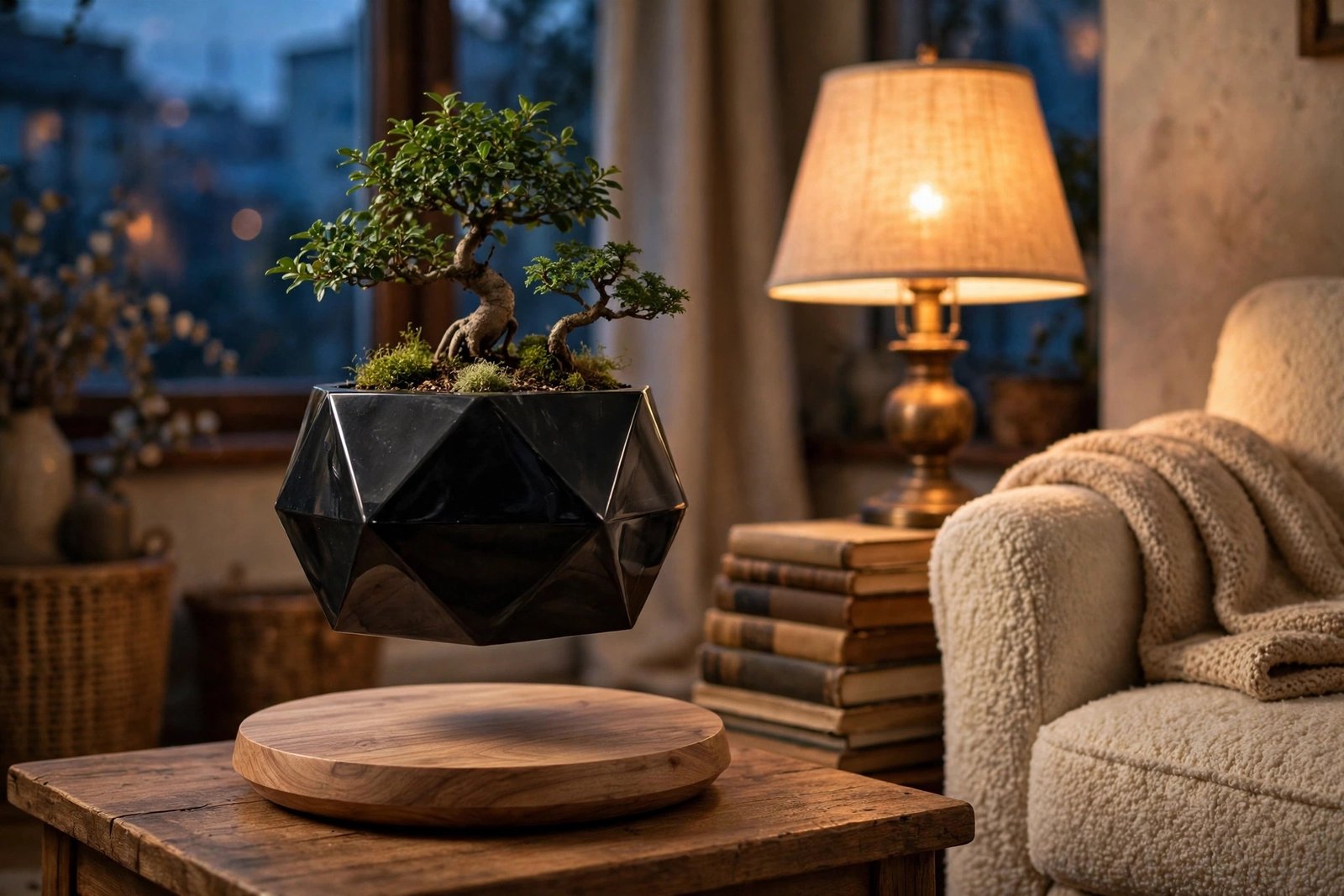
That’s the trick this gadget pulls, and it’s why it photographs so well. Place it on a desk, a bookshelf, or a side table against a calm background, and the floating gap becomes a little stage of negative space. The dark faceted pot reads as modern and sculptural; the round wooden base keeps it warm and organic. It’s the rare tech-gadget that works in a Japandi shelf, a moody home office, or a cozy reading corner — the rotation gives it a slow, meditative quality that suits all three.
It earns its place in the Casa Glow canon for the fall angle alone: as the light goes early, a slowly turning plant catching lamplight is one of the most calming things you can put in a room.
The features that matter — and the ones that don’t
The levitation system
This is the entire product, so let’s be precise about it. The base’s electromagnets do the lifting; the sensors do the balancing. Setup means holding the pot centered over the base and lowering it gently until the field “catches” it — reviewers say it takes a few tries the first time and about ten seconds once you know the feel. Keep the plant’s weight centered and under the 300-gram limit, and it floats steadily. This is real, working maglev, not an illusion, and it’s the reason the product has survived years of trend cycles.
The 360-degree rotation
Once levitating, the pot begins a slow automatic rotation. This isn’t just theater: for a real plant, even light from all sides means more even growth. For the rest of us, it means the “good side” of the arrangement is always facing the room. It’s silent — no motor hum to notice in a quiet office.
The 300-gram limit
The honest constraint. Three hundred grams is a small succulent, an air plant, or a young bonsai with light soil — not a mature houseplant. This is a desk-scale object, about 7 inches tall overall, and it should be styled like one: a jewel on a shelf, not a floor statement. Buyers who expected a large planter are the ones who leave disappointed; buyers who wanted a small floating sculpture are the ones who leave five stars.
The honest review: pros and cons
What we love
- The effect is genuinely magical in person. Reviewers call it a conversation starter more than any other single phrase — guests notice it, touch the air under it, and ask how it works.
- It works as advertised: stable, silent, steady rotation once you learn the setup. “Easy to set up” and “works as advertised” recur across the positive reviews.
- The design is a real object, not a toy — polished dark resin with faceted, planet-like geometry over a warm wooden base. It looks expensive on a styled shelf.
- The slow rotation is quietly practical for live plants, giving even light exposure from all sides.
- Multiple reviewers praise Babook’s customer service when units arrive with issues — a meaningful signal for a gadget with floating parts.
What we’d flag before you buy
- The one real caveat: if the power cuts or the pot gets bumped hard, it drops. The levitation needs electricity, always. Keep it away from high-traffic edges, curious cats, and toddlers — and know that a power outage means a fallen pot.
- It’s small — 7 inches tall, 300-gram capacity. Style it as a desk jewel, not a room anchor.
- There are no drainage holes, so live plants need careful watering (a few reviewers found workarounds; most use succulents or air plants).
- A consistent thread in critical reviews: the resin finish and long-term durability don’t feel premium to everyone, and the bundled decorative plant can look artificial — bring your own plant.
None of these are dealbreakers — they’re the honest texture of a gadget that 836 people rated 4.3 stars. The single most important thing is placement: give it a stable, low-traffic surface and it will quietly delight you for years.
Who it’s for
- The desk stylist — if your workspace is your sanctuary, this is the one object on it that everyone asks about.
- Plant lovers with small collections — succulents, air plants, and young bonsai fit the 300-gram brief perfectly.
- Gift buyers — “unique decoration, awesome gift” is the listing’s own pitch, and the reviews agree: it’s a memorable gift for plant lovers, tech lovers, and design lovers alike.
- Calm-corner builders — the slow rotation and floating gap give a reading nook or meditation corner a genuinely meditative focal point.
It’s not for the household with toddlers or counter-surfing cats, or for anyone who wants a large statement planter — the physics of levitation demand a small, light, undisturbed stage.
One styling tip
Don’t crowd it. The magic of this object is the empty air around it — give the floating gap visual breathing room by placing the base on an otherwise clear surface, with a calm backdrop behind it. A dark walnut desk against a light wall is the ideal stage: the black pot pops, the wooden base glows, and the levitation gap reads as pure theater. Then add one warm light source to the side — a small lamp or even a candle — so the faceted pot catches highlights as it turns. The rotation does the rest.
Price check: Amazon vs. the marketplaces
Amazon is our primary pick: the Dark Color variant was around $67.99 when we checked, carrying its 4.3-star average across 836 ratings. We looked for the exact Babook unit on Temu and AliExpress and could not verify a genuine equivalent — the marketplaces carry similar levitating pots from other sellers, but without the Babook review track record or a verifiable identical listing, Amazon is the buy. (Temu’s affiliate link format is still pending on our side, so we link Amazon only for now.)
We independently select these products — if you buy from one of our links, we may earn a commission at no cost to you. All prices were accurate at the time of publishing.
FAQs
How does the Babook levitating plant pot work?
Magnets, coils, and sensors in the wooden base create an electromagnetic field that suspends the planter in mid-air, adjusting thousands of times per second to keep it balanced. Once floating, the pot rotates slowly and silently on its own. It needs to stay plugged in — no power, no levitation.
What happens if the power goes out?
The pot drops onto the base. This is the product’s one real caveat: keep it on a stable surface away from edges, and don’t place anything fragile directly beneath it.
Can I use a real plant in it?
Yes — small ones. The pot supports up to 300 grams, so a succulent, air plant, or young bonsai with light soil is ideal. There are no drainage holes, so water sparingly. Many owners use air plants to sidestep watering entirely.
Is it hard to set up?
It takes a few tries the first time: you hold the pot centered over the base and lower it slowly until the magnetic field catches it. Reviewers say it becomes a ten-second job once you learn the feel.
Is the Babook levitating pot worth it?
For what it is — a working maglev sculpture that happens to hold a plant — yes, at 4.3 stars across 836 ratings. Buy it for the daily delight of watching your plant float and turn; treat it as kinetic art first and a planter second.
The verdict
Every fall needs one object that makes the house feel a little more magical — and a plant that floats in mid-air is hard to beat. It passes the Casa Glow test: sculptural in daylight, mesmerizing in lamplight, genuinely conversation-starting, and priced like the piece of working physics it is.
Our score: 7/10 — trend 8, rating 7, commission 6, photogenic 9, price fit 7.
Keep exploring: The corner lamp that paints your room in light · The TikTok-viral astronaut galaxy projector · Fall’s glowing mercury-glass pumpkin


