This post contains affiliate links. As an Amazon Associate I earn from qualifying purchases. We independently select these products — if you buy from one of our links, we may earn a commission at no cost to you. All prices were accurate at the time of publishing.
Turn Off the Lamp, Turn On the Stars
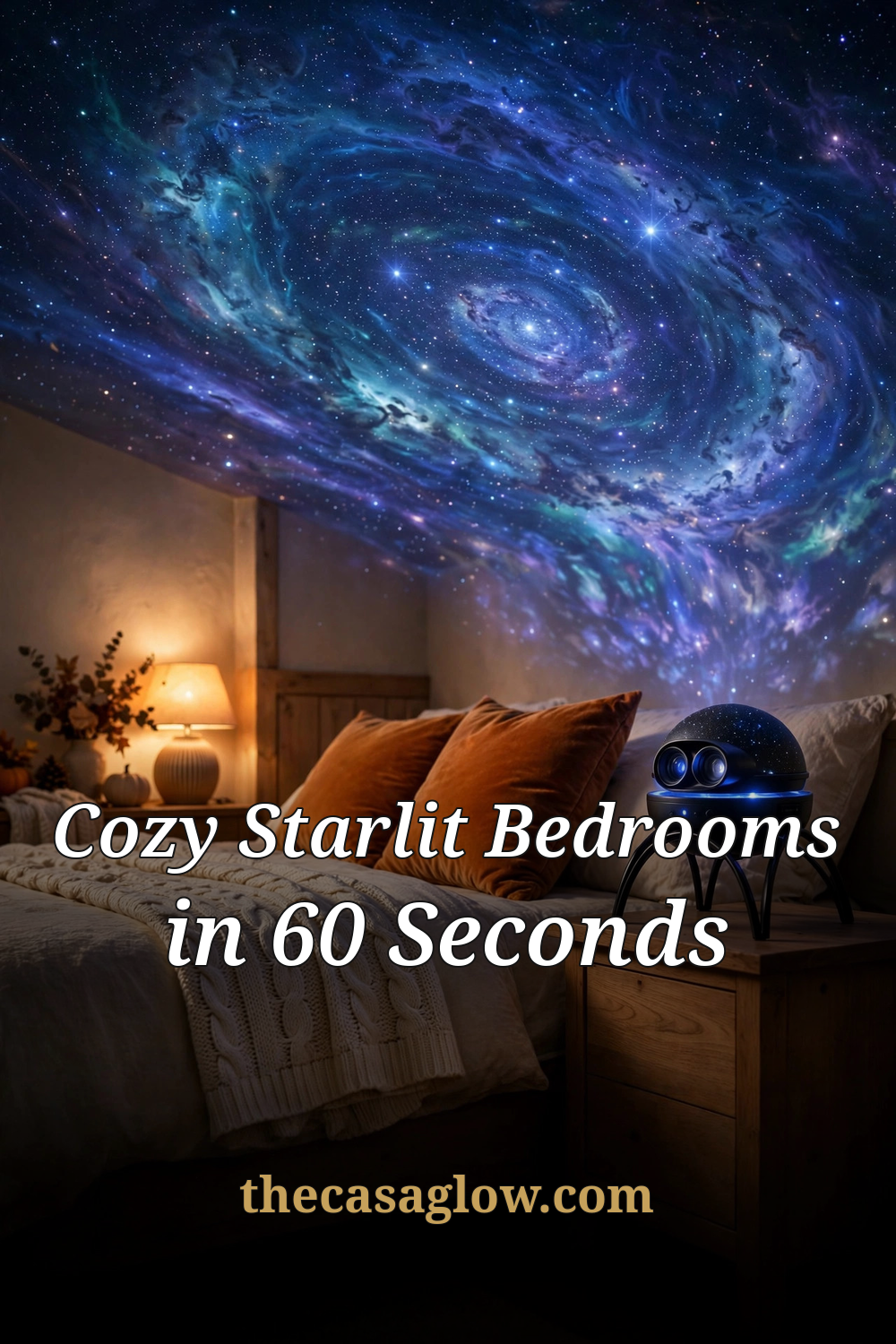
There is a particular feeling at 10 p.m. when the day’s noise finally drains away — the room is dark, the bed is made, and all you want is a reason to look up at the ceiling and let your mind go quiet. Star projectors exist for exactly this moment, and the Rossetta Dual Lens Galaxy Projector is the one that kept surfacing, night after night, in our trend checks: an Amazon’s Choice pick riding the cozy-room wave on TikTok and Pinterest, with a design that looks less like a gadget and more like a small spacecraft that landed on your nightstand.
So we did what we always do: we researched it properly. We read the listing’s photos against the real thing, dug through hundreds of owner reviews and analyses, checked it across Google Trends, Pinterest, Amazon, and Etsy demand signals, and compared every feature against the print. What follows is the honest verdict — what this projector actually does to a bedroom, where it shines, and the caveats you should know before the aurora seduces you.
A note on the numbers: Amazon serves automated checks a hard bot-wall (it flagged ours with an explicit anti-AI-agent notice), so we could not live-verify the current price, star rating, Prime status, or stock on the day of publishing. The listing page linked below always shows today’s real figures — check them there. Nothing below prints a price or rating we could not confirm.
What it is, and how it actually works
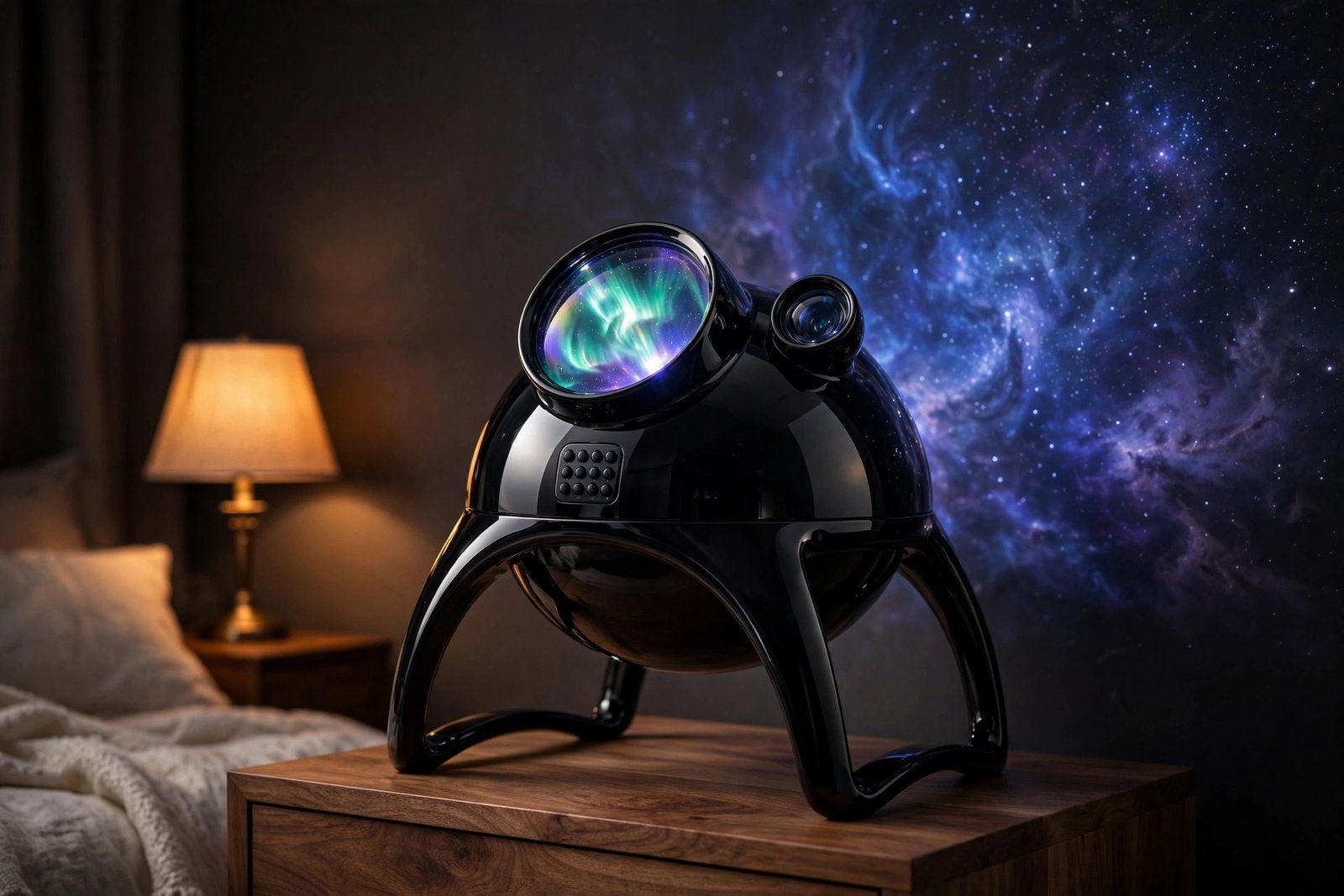
Strip away the poetry and the Rossetta is a compact tabletop projector with an unmistakable design. The body is a glossy dome — a little space capsule in Space Black, Space White, Space Blue, or several softer shades — perched on two prominent curved arch legs that give it a wide, stable stance. On top sit two raised circular lenses: a larger iridescent lens that throws the aurora wash in greens, purples, and blues, and a smaller secondary lens beside it that layers the starfield. A small control panel with a grid of buttons sits on the front of the dome, and the whole thing runs over USB.
The signature trick is the dual-lens system. One lens paints the drifting aurora/nebula clouds; the other pins thousands of tiny stars across them. The listing advertises 58 combined light-effect modes, so the show is genuinely varied — soft drifting aurora one night, dense starry sky the next, both layered for the full planetarium effect. A companion app (with a clean blue-gradient interface, per the brand’s product photos) and a chunky black remote with red and white buttons give you control from bed.
Then there is the part most projectors skip: this one is also a Bluetooth speaker with 15 built-in white-noise sounds — ocean waves, rain, and the rest of the wind-down canon. A music-sync mode pulses the lights to whatever is playing. And there is an auto timer, so the stars fade out on their own after you have drifted off. It is not a lamp with a trick; it is a bedtime ritual in a box.
Why it works in a room
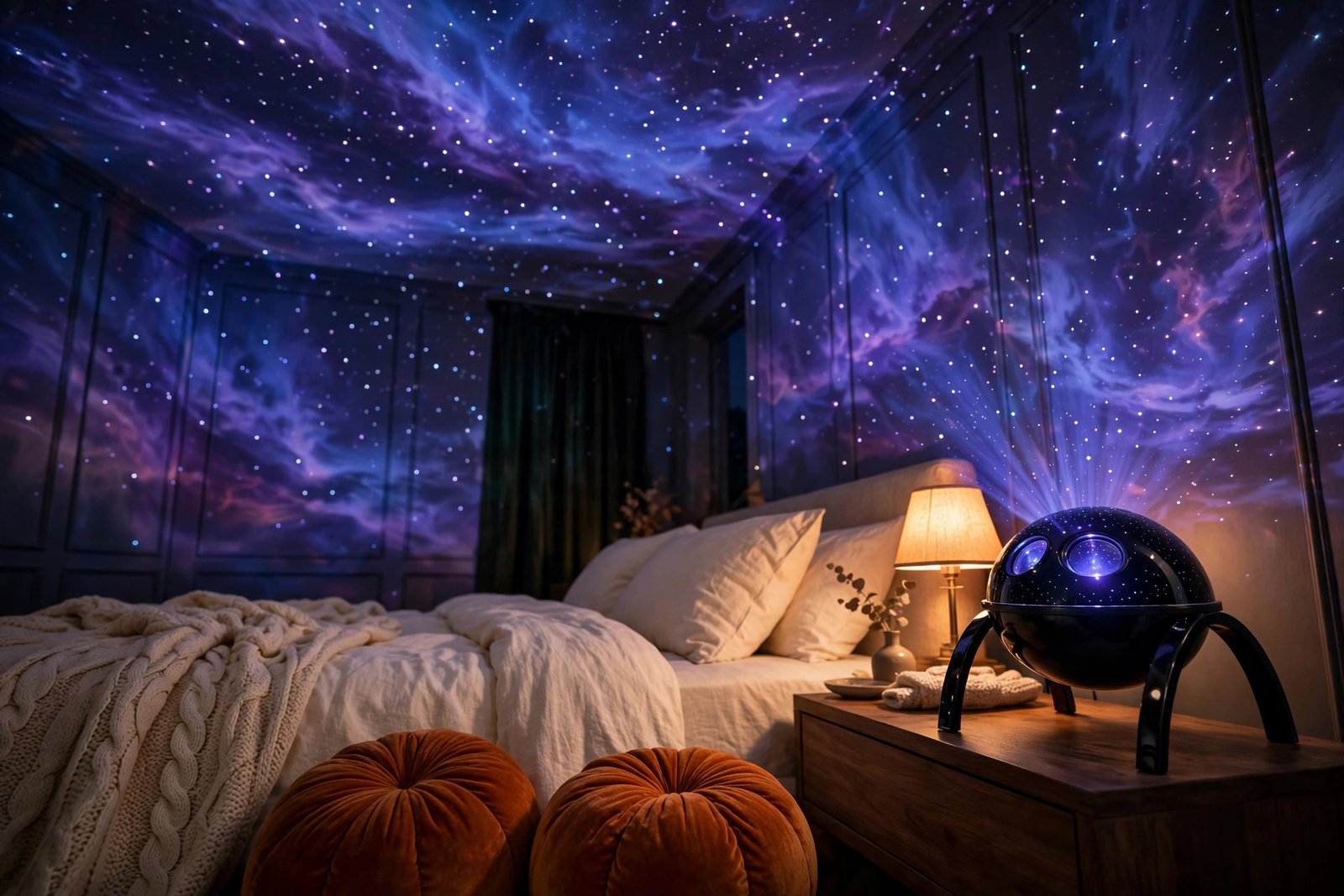
Most lighting decorates the room. A galaxy projector redecorates the ceiling and walls — and those are the largest surfaces in every room you own. That is the design logic here: one small object, barely bigger than a grapefruit, transforms an entire bedroom into a planetarium. It is visual leverage. Stylists spend thousands on limewash and murals to get this kind of atmosphere overhead; this gets you there in an evening for the cost of a takeaway order.
It also plays beautifully with the cozy-room styling we keep returning to on this blog. Warm amber lamps, velvet pumpkin pillows, chunky cable-knit throws — everything in the warm fall palette gets a counterpoint from cool starlight. The projector does not compete with your decor; it is a stage light for it. Dim the lamps, let the aurora roll across the ceiling, and the whole bedroom reads as deliberate — the kind of room that photographs itself.
The honest pros and cons
Pros. The effect is real and, frankly, a little magical: owners consistently describe falling asleep under the aurora as the product’s core joy, and the dual-lens layering means the projection has depth — stars in front of drifting nebula clouds, not a flat wallpaper pattern. The Bluetooth speaker plus white noise is the feature that turns a novelty into a nightly habit: rain sounds and stars, one device, no phone needed. The remote and app mean full control from bed, the timer means no 3 a.m. guilt about leaving it on, and music-sync mode makes it a party piece too. For room-tour creators and Pinterest stylists, it is an instant viral backdrop without waiting for clear skies.
Cons. Now the honesty. Like every light projector on the market, this one needs real darkness to sing — in a room with the lamps still on, the aurora is a whisper, not a shout, so it is an after-lights-out companion, not an evening accent. Review analyses flag that projection sharpness varies with throw distance and ceiling height, so temper the planetarium expectations in rooms with very high ceilings. USB-only power is a leash — there is no battery inside, so it lives within cable reach of a socket or power bank. And a gadget this visually loud is a commitment: it suits the cozy-bedroom-and-kids-room set far more than the minimalist living room.
Who it is for (and who should skip it)
This projector is for the night owl who reads under warm lamplight and then wants the room to do the winding down, the parent building a calmer bedtime for a star-obsessed kid, the renter whose walls cannot be painted and whose ceiling is the only canvas left, and anyone styling a cozy fall bedroom who wants the cheapest possible drama-per-square-foot. If your evenings run on lo-fi playlists, warm textiles, and low light, it will feel like it was made for your house.
It is not for the reader who needs real task light — this is atmosphere, not illumination; do not try to read by it. It is not for the purist who wants gallery-accurate color overhead. And if your evenings end in a brightly lit room, start with real warmth instead: our candle warmer lamp review and amber glass table lamp guide cover the tabletop side of cozy lighting, and our cordless wall sconce guide handles the renter-friendly fixtures that do the actual lighting work.
The dark-room technique (read this before you plug it in)
Here is the single trick that separates a disappointing galaxy projector from a stunning one: darkness controls everything. The projection’s punch scales with how dark the room is. Start by turning off every lamp, closing the curtains, and giving your eyes two minutes to adjust. Place the dome three to six feet from the largest clear wall or ceiling you have — a nightstand aimed at the ceiling above the bed is the classic, most forgiving setup. Run the aurora and starfield layered together for the first night; the depth is what sells the illusion. Set the timer for an hour so it fades as you drift off, and cue the rain white-noise under it. It takes five minutes of setup and pays off every night after.
Fall styling pairings that make it sing
A galaxy projector alone is a novelty; a galaxy projector inside a considered bedroom is a whole mood. This fall, pair it with textures that drink in the contrast: burnt-orange velvet pillows catch the cool starlight at their edges and glow like embers against it. A chunky cable-knit throw in cream softens every blue edge in the room. A small amber glass candle holder on the nightstand beside the dome gives you the warm counterpoint — the projector does the sky, the candle does the hearth. And keep the bedding light: white and cream linens reflect the aurora faintly, which is exactly what you want the room to do.
The verdict
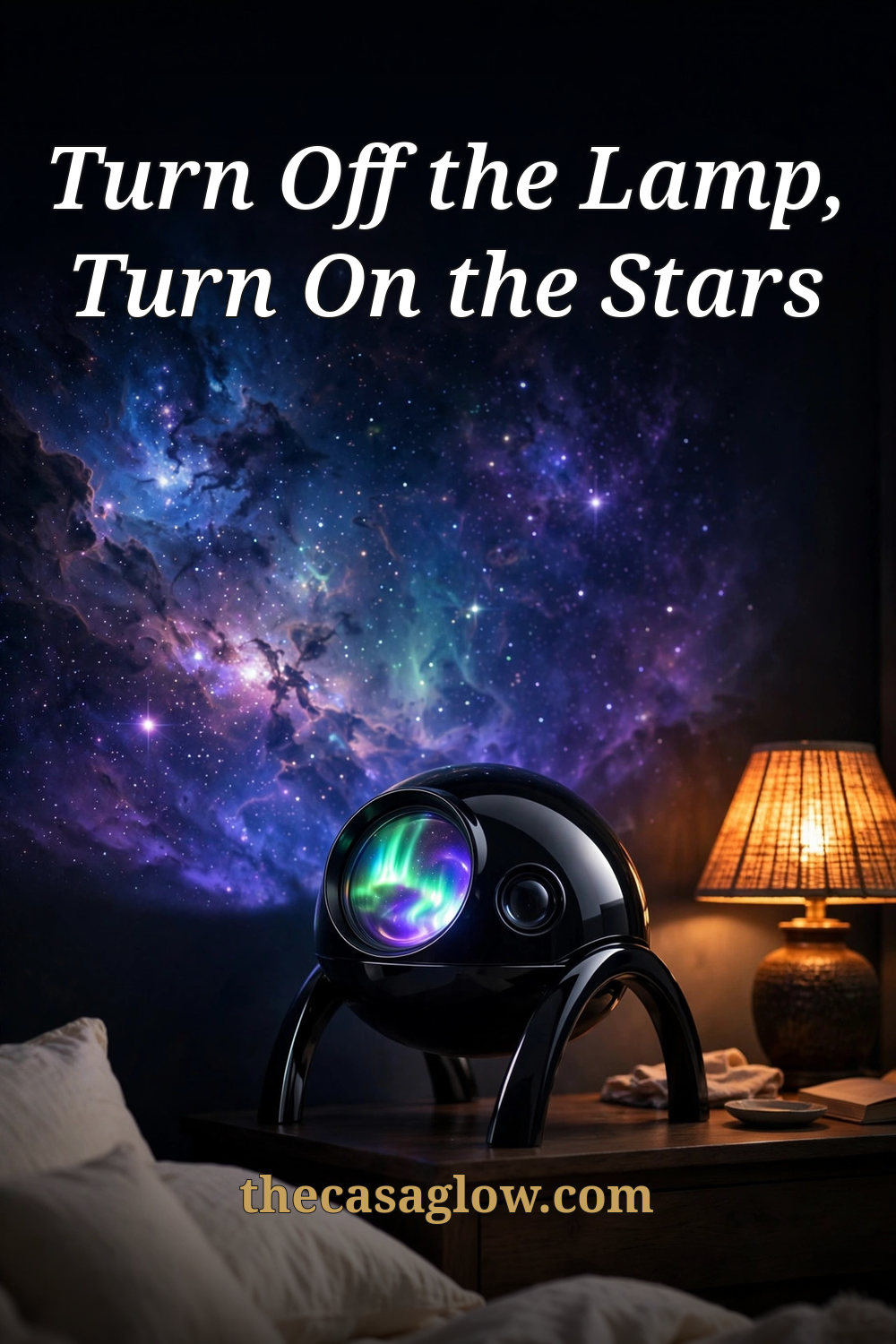
The Rossetta dual-lens galaxy projector earns its trend signals. It is a genuinely well-designed object — that little space-capsule dome looks intentional on a nightstand, not toy-like — and it does the one thing it promises better than the flat single-lens projectors it competes with: depth. Aurora in front, stars behind, sound underneath. For a cozy bedroom, a kid’s room, or a wind-down ritual that does not involve a screen, it is one of the easiest yeses in mood lighting we have reviewed.
Our standing advice applies: check the live listing for today’s price and Prime terms before you buy — those shift — and give it the darkness it deserves on night one. Do that, and your ceiling stops being a ceiling.
Rossetta Dual Lens Galaxy Projector — Bluetooth speaker, white noise, remote & timer. Live price and Prime terms on the listing page.